How To Compare Quartz And Mechanical Watches For Daily Use
A practical step-by-step guide to how to compare quartz and mechanical watches for daily use, including preparation, instructions, common issues, tips, and next steps.
How To Compare Quartz And Mechanical Watches For Daily Use
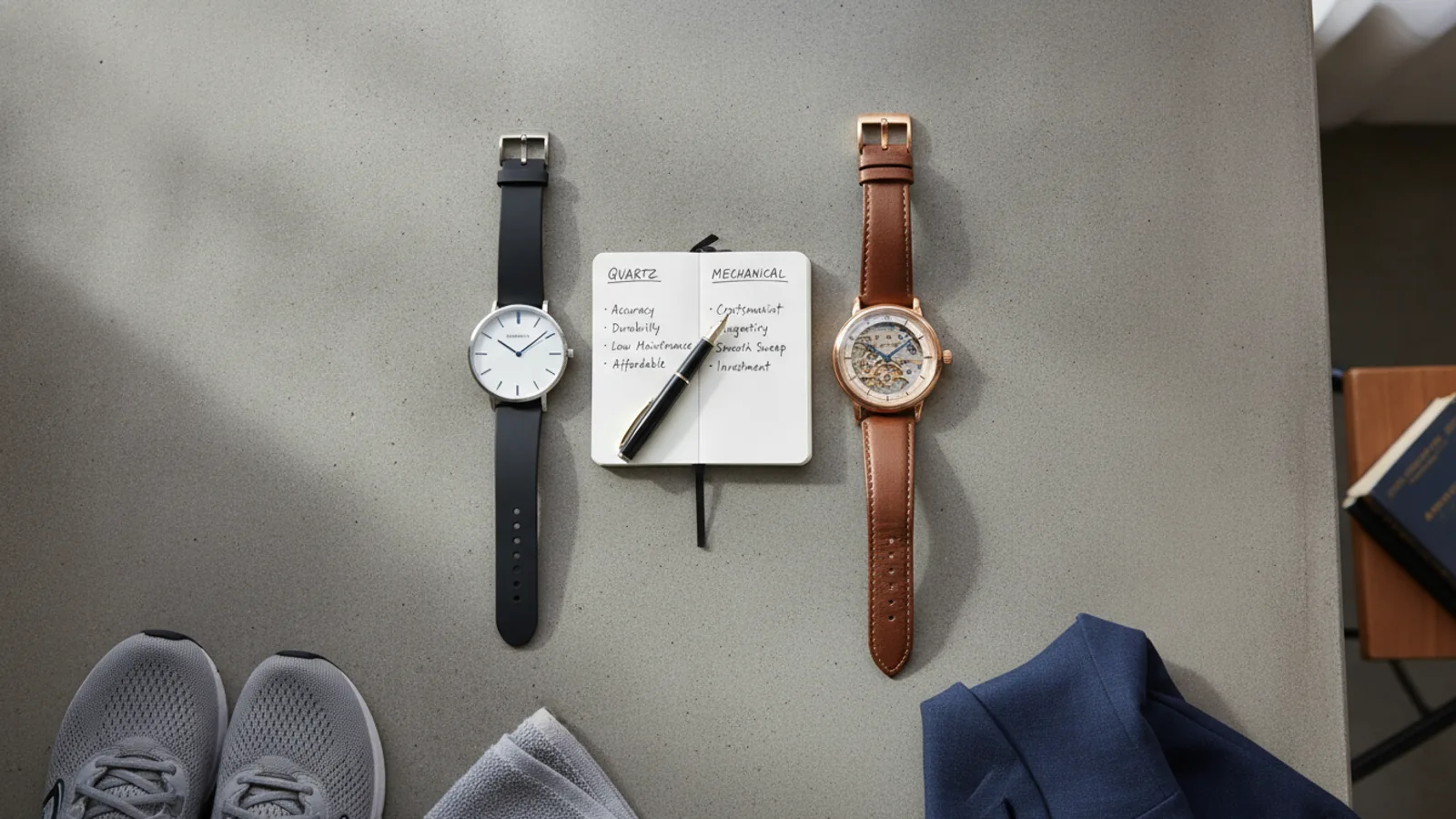
Choosing between quartz and mechanical watches for daily wear depends on your priorities: quartz offers precision, low maintenance, and affordability, while mechanical provides craftsmanship, tradition, and the satisfaction of owning a piece of horological art. This guide compares their accuracy, power source, maintenance needs, durability, and daily usability, helping you decide based on your lifestyle, preferences, and how much effort you want to invest in keeping your watch running.
Fast Answer
- If you value accuracy and low maintenance, choose a quartz watch: it requires no winding, is highly precise, and needs only a battery change every few years.
- If you appreciate craftsmanship and don't mind winding a watch daily or owning an automatic that keeps running with motion, choose a mechanical watch.
Before You Start
- Understand the basic difference: quartz watches use a battery and a quartz crystal to keep time, while mechanical watches use a mainspring and gears, either manual (hand-wound) or automatic (self-winding via wrist motion).
- Consider your daily routine: are you someone who wants a hassle-free timepiece, or do you enjoy the ritual of winding and caring for a traditional instrument?
- Evaluate your tolerance for timekeeping deviation: quartz watches typically gain or lose a few seconds per month, while mechanical watches may deviate several seconds per day.
- Think about long-term service costs: quartz batteries are cheap and easy to change, whereas mechanical movements require periodic professional servicing that can be costly and time-consuming.
Step-by-Step Instructions
Assess Your Timekeeping Accuracy Needs
First, consider how precise your watch must be for your daily life. If you rely on your watch for punctuality, such as catching trains, attending meetings, or timing medication, quartz is the clear winner. Quartz movements are driven by a battery that sends electrical pulses to a tiny quartz crystal, which vibrates at a precise frequency, resulting in accuracy within a few seconds per month. In contrast, mechanical movements are regulated by a balance wheel and hairspring, which can be affected by gravity, temperature, and position, leading to deviations of -4 to +6 seconds per day, even in high-grade movements. For most people, a few seconds a day won't matter, but if you need exact time, quartz avoids the hassle of constant adjustment. To assess your needs, think about how often you currently check your phone or other devices for the correct time. If you find yourself correcting your watch frequently, that's a sign you prioritize accuracy. Also, consider whether you enjoy the character of a mechanical watch, knowing it may run a bit fast or slow, and whether you have the patience to reset it occasionally. The check here is to set your watch and see how many seconds it gains or loses over a week, then decide if that deviation is acceptable for your activities.
Evaluate Your Maintenance Willingness
Next, think honestly about how much time and money you are willing to invest in watch maintenance. Quartz watches are low-maintenance: they require a battery replacement every two to five years, which is inexpensive and can often be done by the owner with the right tools, though some prefer a jeweler. Additionally, quartz watches may need a seal replacement during battery changes to maintain water resistance. Mechanical watches, especially automatics, need more attention. Manual-wind watches require daily or every-other-day winding, a ritual some enjoy but others find tedious. Automatic watches (self-winding) don't need manual winding if worn daily, but they will stop if left unworn for a day or two, so you may need a watch winder or be prepared to set the time again. More critically, mechanical movements require professional servicing every three to five years to clean, lubricate, and regulate the gears, which involves disassembling the movement and can be expensive. If you are not handy or don't want to deal with these tasks, quartz is more convenient. To evaluate your willingness, ask yourself if you enjoy learning about and handling intricate mechanisms, or if you prefer a 'set and forget' device. Also, consider whether you have a reliable watchmaker nearby for servicing mechanical watches, whose availability can vary by location.
Consider Water Resistance for Your Lifestyle
Water resistance is a crucial factor for daily use, whether you get caught in rain, wash your hands frequently, or swim. Quartz watches are not inherently more water-resistant—both types can have high ratings like 100 meters or more—but the way you use them matters. For everyday life, a water resistance of at least 30 meters (3 ATM) can handle splashes and brief immersion, but for swimming, you need at least 100 meters. Mechanical watches are more sensitive to water if their seals fail, and servicing a mechanical watch after water damage is costly. Quartz watches also have gaskets, but they are easier to test and replace. To check water resistance, look at the case back or the watch's documentation; conversely, if you have doubts, take the watch to a jeweler for a pressure test. When wearing a watch, avoid operating the crown or pushers while wet, as that can allow water to enter. If you frequently swim or dive, choose a watch with a screw-down crown and case back, as these are more secure. Also, be mindful that leather straps are not water-friendly; if you plan to get your watch wet, opt for a metal bracelet, rubber, or nylon strap. The practical check: before buying, identify the exact water resistance rating and match it to your typical activities, and always ensure any watch you wear is properly sealed.
Weigh the Impact of Daily Wearing Conditions
Daily wear exposes your watch to shocks, temperature changes, and magnetic fields. Mechanical watches are more susceptible to these influences. A sudden jolt, like tapping a watch on a table, can knock the balance staff, causing the watch to run erratically or stop. Temperature extremes can alter the viscosity of lubricants, affecting accuracy. Magnetic fields, such as from smartphones, laptops, or refrigerator magnets, can magnetize steel parts, causing significant time gain or loss. Quartz watches are more robust against shocks because their electronic oscillator is not affected by gravity or position, and they are less prone to magnetism issues, though the battery can be damaged by extreme heat. However, quartz movements can still be damaged by violent impacts. To handle daily conditions, consider your environment: if you work in a workshop, around heavy machinery, or with magnetic equipment, a robust quartz watch with a sturdy case might be safer. Alternatively, look for mechanical watches with anti-magnetic features like a soft-iron inner case or a silicon balance spring. The check: think about your typical day and note any sources of strong magnets or impacts. If you are prone to dropping or knocking your watch, quartz may withstand those better. Also, if you switch between extreme temperatures, like stepping from a cold winter day into a warm building, condensation can form inside the watch; this is more common in mechanical watches because of their metal components.
Decide on Power Reserve and Convenience
Power reserve is the time a watch will run without winding or without movement. Quartz watches have a power reserve of months to years, as they are powered by a battery that only needs replacement periodically. Mechanical watches have a power reserve of 24 to 72 hours, depending on the movement. For daily use, this means a manual-wind watch must be wound every day, while an automatic watch stops overnight if not worn, requiring resetting. If you alternate between multiple watches, a quartz watch is easier to pick up and go, while a mechanical watch will likely be dead and need setting. Many people find the ritual of winding and setting a mechanical watch endearing, but if it becomes a burden, quartz offers convenience. Also, consider that mechanical watches often have a hacking feature (second hand stops when the crown is pulled) to set to the exact second, which quartz watches also have, but some mechanical movements lack this. To decide, think about how many watches you own and whether you mind paying attention to a watch's power reserve. If you have a collection, quartz watches allow you to rotate without worrying about charging or winding. To check, look for a power reserve indicator on mechanical watches, which shows remaining energy, or note that a watch stops after the weekend, and you can decide if that's acceptable.
Reflect on Your Personal Style and Emotional Connection
The final step is to consider the emotional and aesthetic aspects. Mechanical watches are often prized for their intricate craftsmanship, the smooth sweeping second hand, and the tradition of horology. They can serve as heirlooms and convey a sense of heritage. Quartz watches, while often accurate, have a ticking second hand and are generally viewed as utilitarian. However, modern quartz watches can also be stylish, with high-end designs and advanced features like solar power or radio synchronization. Your personal style matters: a mechanical watch might pair better with formal attire or as a statement of sophistication, while a quartz watch might be more suitable for sporty, active lifestyles. Additionally, the weight and feel differ; mechanical watches are often heavier due to metal parts, which some prefer. To discover your preference, try wearing both types for a week. Notice how you feel when you wind a mechanical watch and hear the gentle ticking, or when you don't have to worry about a quartz watch stopping. The check: imagine wearing a watch every day for years; does the idea of owning a mechanical watch fill you with a sense of satisfaction, or does it feel like a hassle? If you value the story and artistry, mechanical is for you. If you value simplicity and reliability, quartz is better. Ultimately, the best watch is one you enjoy wearing and that fits your practical needs.
Quick Reference
| Situation | Action | Why it helps |
|---|---|---|
| You need to rely on your watch for exact time, such as for work or public transport. | Choose a quartz watch, which typically deviates only a few seconds per month, and set it by the nearest time signal. | Quartz movements use a crystal oscillator that maintains high accuracy, so you won't need frequent adjustments. |
| You've accidentally exposed your watch to water while swimming and it stops or fogs up. | Immediately set the watch to a dry, shaded area and remove the crown to let it dry, then take it to a professional as soon as possible. | Water can corrode the movement and seals; quick drying and professional service can reduce internal damage. |
| You've been wearing your automatic watch all day, but it stops at night, and you want it ready in the morning. | Give it a few gentle turns of the crown to wind it enough to last the night, and keep it on a watch winder if you have one, or just reset and wear it. | Automatics only self-wind when worn, so this manual winding primes it to keep running through inactivity. |
Common Issues
- Your quartz watch runs fast or slow, or stops intermittently.: First, check for a weak battery and replace it, ensuring the battery contact is clean. If the issue persists, the quartz circuit or motor might be defective, requiring a professional movement replacement.
- Your mechanical watch is losing or gaining several seconds per day, beyond acceptable limits.: Schedule a regulation service with a watchmaker, who can adjust the balance wheel's effective length to improve precision. Also, ensure it is not magnetized by getting a demagnetization.
- Your watch's crown or pushers become tight or hard to operate.: Do not force it; take it to a jeweler to clean and relubricate the stem and gaskets. This is especially important for water resistance, as a stiff crown may indicate a dried gasket.
Advanced Tips
- If you own multiple mechanical watches, invest in a watch winder that mimics wrist motion, but use it selectively to avoid over-winding, which can stress the movement.
- For quartz watches, consider models with a power reserve indicator or a 'battery end-of-life' feature, so you'll know when to change the battery before it stops abruptly.
- To keep a mechanical watch accurate, store it dial-up at night, as this position often provides the least positional error in many movements.
Final Checklist
- Verify that your watch's water resistance rating covers your typical exposure, and ensure all crowns are properly sealed.
- Check whether your watch's power source (battery or mainspring) matches your routine of wearing and caring for it.
- Plan for service intervals: note when your quartz battery will need replacement and when your mechanical movement should be serviced, and budget accordingly.
- Test your watch's accuracy and magnetism before buying or during ownership to confirm it meets your expectations.
FAQ
Can a quartz watch last as long as a mechanical watch?
Quartz watches have fewer moving parts, so they can last a long time, often with occasional battery changes. However, their electronic components may fail, and some affordable models are not designed to be repaired. Mechanical watches, if well-made and properly serviced, can last generations. Longevity largely depends on build quality, service history, and care, not just the type of movement.
Is it necessary to wind a manual mechanical watch every day?
Yes, most manual-wind watches need winding once daily to maintain power. Some have a longer power reserve, like 36 hours, but to keep it running accurately and consistently, a daily winding ritual is recommended. Check the watch's power reserve specification, but a healthy habit is to wind it at the same time every day, ideally in the morning.
Does wearing a mechanical watch daily eliminate the need for winding?
Automatic mechanical watches, which are self-winding, will keep running as long as you wear them, because your wrist motion winds the mainspring. However, if you take the watch off for a night and a day, it may stop, so it’s wise to give it a few manual turns before putting it on to ensure it starts. Manual watches always need winding regardless of wear.